

 Facebook
 X
X
 Pinterest
 Copy Link
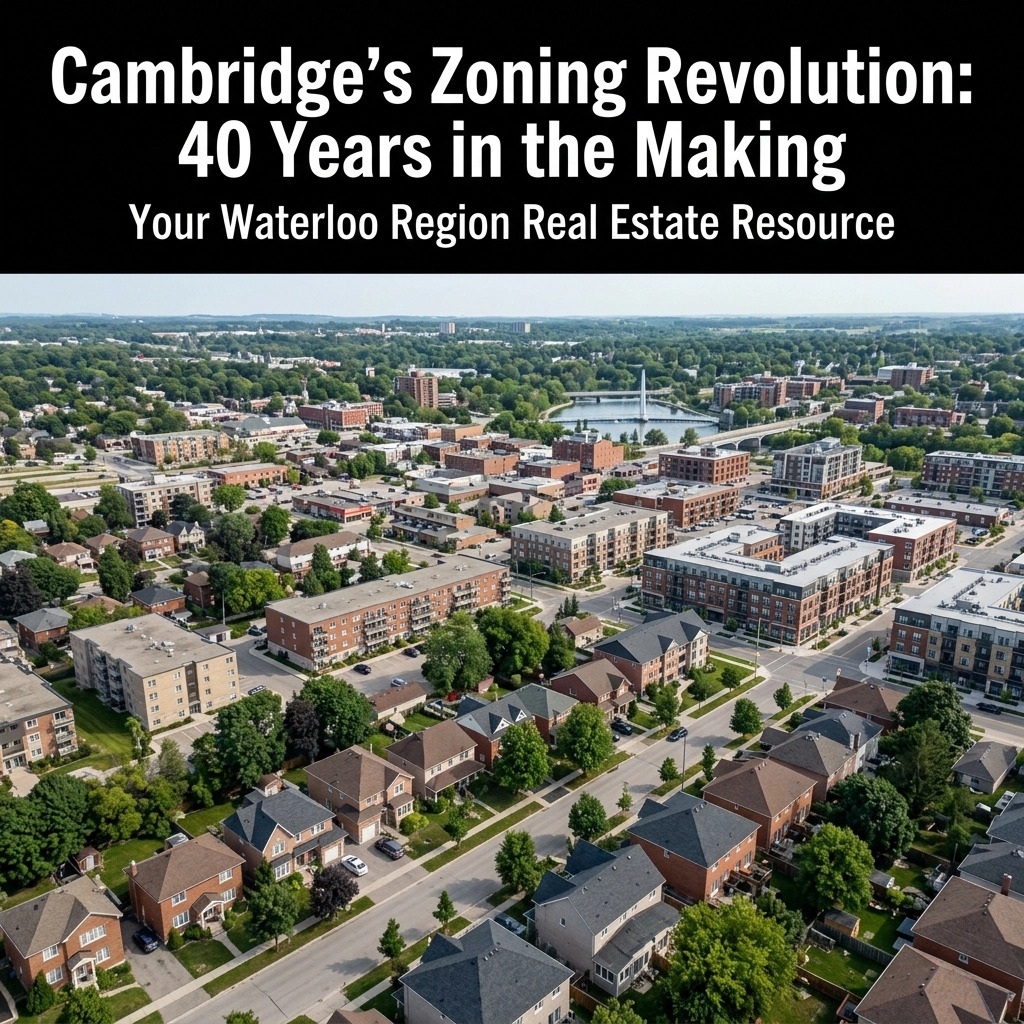
![[HERO] Cambridge’s Zoning Revolution: 40 Years in the Making](https://cdn.marblism.com/OkdtRRHp9oy.webp)
If you’ve spent any time driving through the Galt, Preston, or Hespeler areas lately, you’ve probably noticed that Cambridge is changing. But while the cranes in the sky tell one story, the real revolution has been happening inside City Hall.
For the first time in roughly four decades, the City of Cambridge has completely overhauled its residential zoning rules. This isn’t just a minor “tweak” to the bylaws; it is a fundamental shift in how our city will be built for the next generation. As a real estate broker who lives and breathes the Waterloo Region market, I can tell you that this is one of the most significant policy shifts I’ve seen in my career.
Let’s pull back the curtain on what this “40-Year Refresh” actually means for you, whether you’re a homeowner, an investor, or someone just trying to find an affordable place to call home.
Out With the Old: Moving from “Use” to “Form”
Since the 1980s, Cambridge operated on what we call “use-based” zoning. Essentially, the city would tell you exactly what a building could be used for: usually a single-family home: and that was about it. It was rigid, it was outdated, and frankly, it was a major hurdle to addressing our housing shortage.
The new system officially shifts us toward “form-based” zoning. Instead of focusing solely on the “use” of the building, the city is now looking at the “form”: how the building fits into the space, its height, its scale, and how it interacts with the streetscape. This gives builders and homeowners significantly more flexibility.
Simplifying the Map: 16 Zones Down to 4
One of the biggest frustrations for anyone trying to develop property in Cambridge was navigating 16 different, complex residential categories. It was a bureaucratic maze. As of the February 2026 updates, those 16 zones have been consolidated into just four streamlined categories:
- RR (Rural Residential): Reserved for large-lot detached homes, maintaining the character of our more open spaces.
- R1 (Low-Rise 1): This is the game-changer for most neighbourhoods. It permits duplexes, triplexes, and small multi-units “by right,” meaning you don’t need a special mountain of paperwork to build them. These can go up to 3 storeys.
- R2 (Low-Rise): Similar to R1 but designed for smaller urban lots. On major roads, these can now reach up to 4 storeys.
- R3 (Mid/High-Rise): This is where we see the density. Targeted for major corridors, these zones allow for 5 to 15 storeys depending on the specific location.
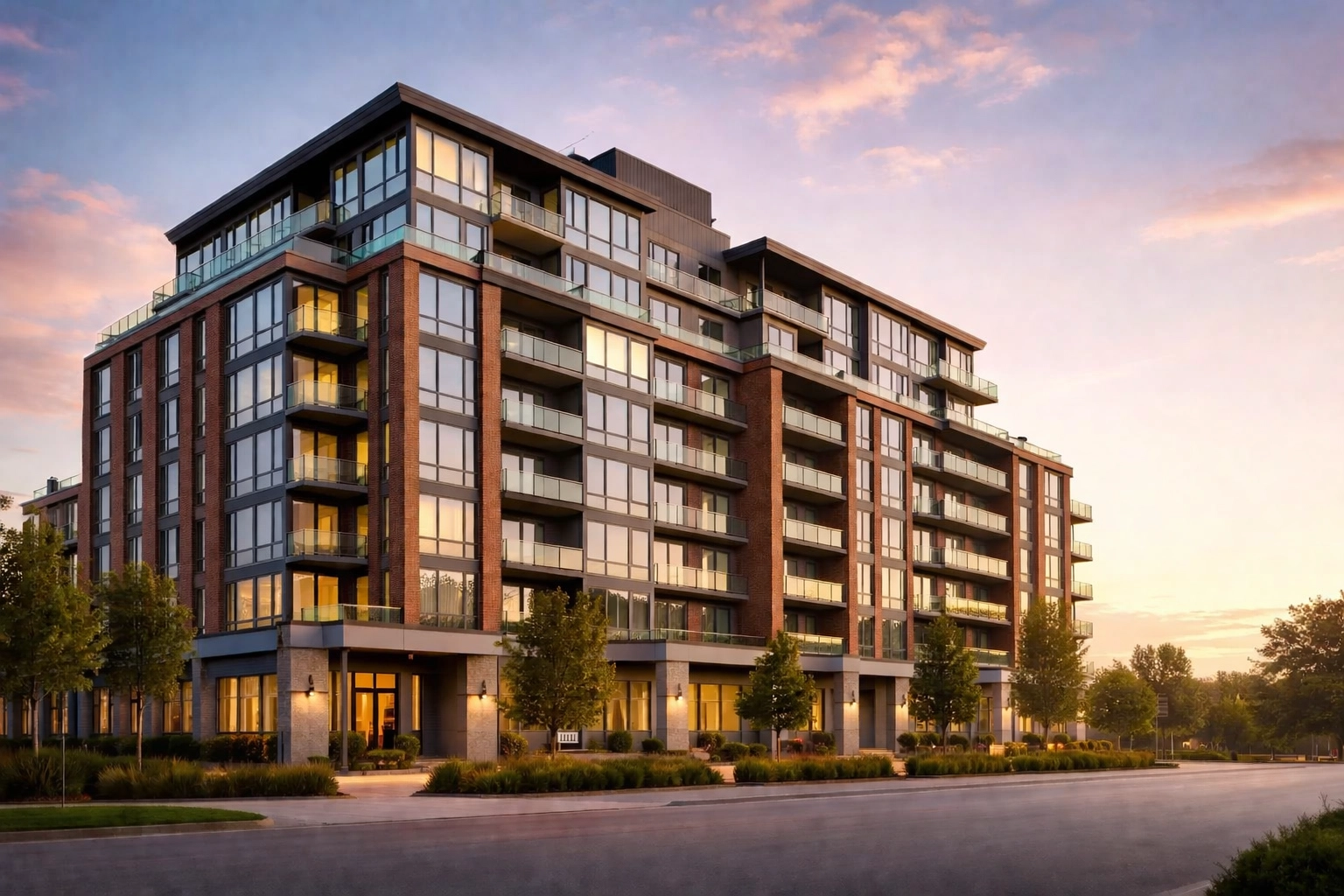
This consolidation makes it much easier to understand what can be built where. If you’ve been following the news about fourplexes in Kitchener, you’ll see that Cambridge is following a similar path toward density, but with its own unique “form-based” twist.
The “Four-Unit” Compromise
It wasn’t all smooth sailing at the Council meeting on February 4, 2026. One of the most debated points was how much density to allow in traditional low-rise neighbourhoods.
To balance the need for more housing with the desire to protect existing streetscapes, Council passed a 6-3 amendment that caps density at four housing units on many low-rise lots. This “Four-Unit Compromise” was a strategic move. It allows the city to satisfy federal funding requirements while ensuring that a quiet street doesn’t suddenly turn into a wall of high-rises overnight.
For homeowners, this is huge. It means you may have the opportunity to convert your basement or add a garden suite, potentially increasing your property value and providing much-needed rental income.
The $13.3 Million Deadline
You might be wondering why this happened so fast. The answer, as it often is, comes down to funding. The federal government’s Housing Accelerator Fund (HAF) is a massive carrot dangled in front of municipalities to encourage zoning reform.
Cambridge was working against a deadline to secure a total federal commitment of $13,347,095. This money isn’t just a gift; it’s tied to a very specific target: Cambridge must facilitate the creation of 2,972 new units over the next three years.
This funding is critical because it helps pay for the infrastructure that supports new housing: things like pipes, roads, and services. We’ve seen in other parts of the region how infrastructure limits can stall development, such as the recent townhome projects in South Kitchener that barely beat a water capacity freeze. Cambridge is using this $13.3 million to make sure they stay ahead of those issues.

Enter the “Digital Twin”: AI-Powered Approvals
Perhaps the most “future-forward” part of this revolution is how the city plans to handle development applications moving forward. Part of the HAF deal involves Cambridge launching a “Digital Twin” platform in 2026.
This is essentially a 3D digital model of the entire city. It uses AI to fast-track development applications from the initial pre-consultation stage all the way to the final permit. Instead of waiting months for a human to manually check if a building’s shadows will affect a neighbour’s yard, the AI can simulate it in seconds.

This technology is expected to drastically reduce the “red tape” that has historically slowed down home construction in Ontario. For my clients looking to build or renovate, this could mean a much faster turnaround time and less money spent on carrying costs while waiting for approvals.
What This Means for Cambridge Homeowners
If you own a home in an R1 or R2 zone, your property just became more versatile. While not everyone wants to become a landlord, the potential to add units increases the underlying land value. We are seeing a shift where “highest and best use” for a property is no longer just a single-family dwelling.
However, with more density comes more questions about transit and amenities. With the LRT expansion to Cambridge still a major topic of discussion, these new zoning rules are designed to put people where the transit is: or where it’s going to be.

Looking Ahead
According to recent data from the Cornerstone Association of Realtors, the demand for housing in the Waterloo Region remains resilient, even as we navigate a more balanced market. This zoning reform is a proactive step to ensure Cambridge isn’t left behind as our region continues to grow.
It’s been 40 years since we’ve seen a shift this big. Whether you agree with every part of the plan or not, one thing is certain: the Cambridge of 2030 will look very different from the Cambridge of today.
If you’re wondering how these zoning changes affect your specific property value, or if you’re looking to invest in a neighbourhood that’s primed for this new “R1” or “R2” density, I’m here to help. Navigating these changes is exactly what I do.

Kim Louie, Real Estate Broker partnered with Coldwell Banker Peter Benninger Realty | Your Waterloo Region Real Estate Resource
📲 519.573.0837
📧 realtorkimlouie@kimlouie.net
💻 www.kimlouie.net
*** Not intended to solicit clients under contract. Content is for informational purposes and not guaranteed nor warrantied ***
#CambridgeOntario #RealEstate #ZoningReform #HousingAcceleratorFund #WaterlooRegion #KimLouie #UrbanPlanning #Cbridge #PropertyInvestment #SmartGrowth
