

 Facebook
 X
X
 Pinterest
 Copy Link
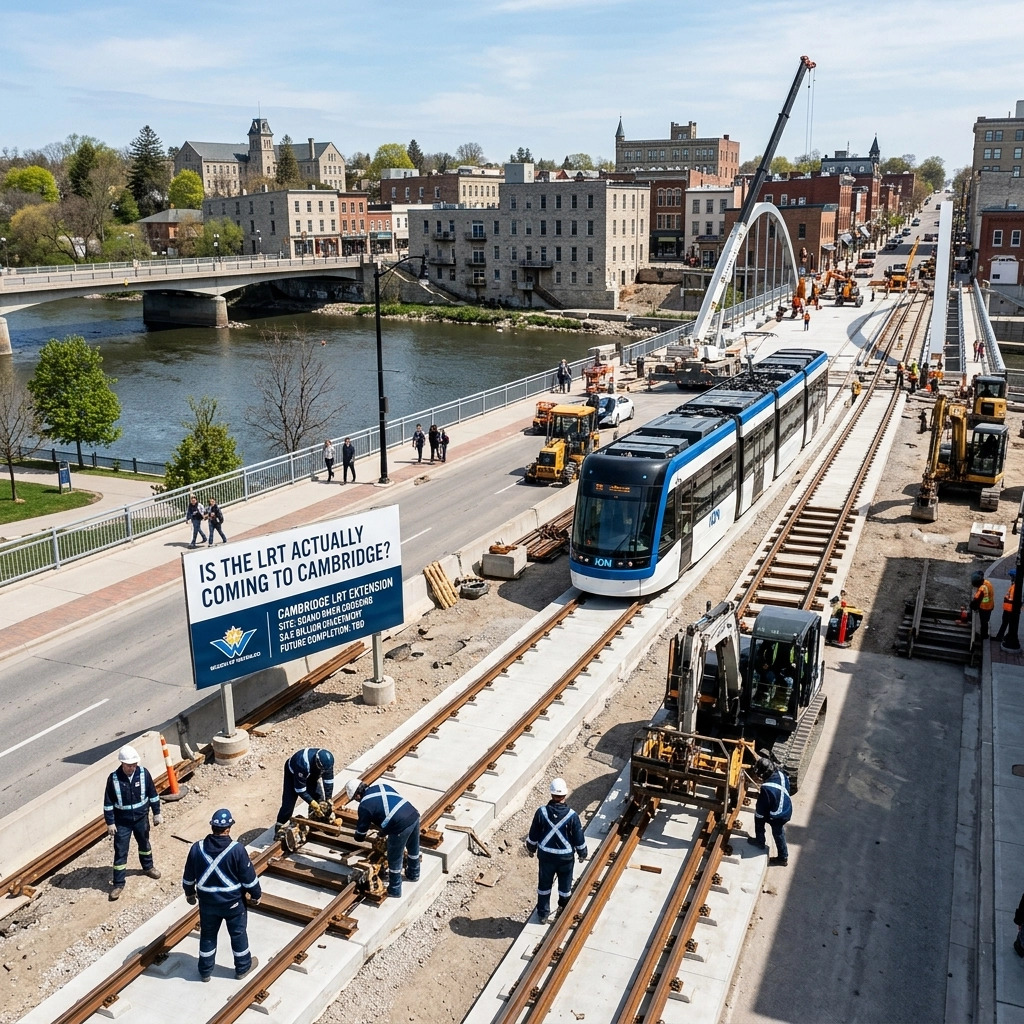
![[HERO] Is the LRT Actually Coming to Cambridge? The $4.5 Billion Question](https://cdn.marblism.com/KAkR_YmtaIB.webp)
If you’ve lived in Cambridge for more than five minutes, you know that the “LRT debate” is basically our unofficial municipal sport. For years, we’ve watched those sleek blue-and-white ION trains glide through Kitchener and Waterloo, while we’ve been left wondering when, or if, they would ever make their way down the Shantz Hill stretch into our neck of the woods.
Well, this month, March 2026, we just took a massive leap forward. But as with everything in municipal politics, it’s not without a few speed bumps. The Region of Waterloo officially endorsed the $4.5 billion Phase 2 business case, moving us closer to reality than we’ve ever been. At the same time, Cambridge Council recently split 5-4 on a motion asking for a $60 million ION reimbursement.
So, the $4.5 billion question remains: Is this actually happening? And more importantly for you, what does it mean for your property value in the south end today, years before the first track is even laid?
The Political Tug-of-War: The 5-4 Split
Earlier this month, the local conversation got heated. Cambridge Council was divided, voting 5-4 to seek a $60 million reimbursement from the Region of Waterloo. This request stems from the costs Cambridge has already incurred or will incur related to the transit expansion.
This narrow split highlights the tension many of us feel. On one hand, we want the modern connectivity and the “big city” amenities that come with light rail. On the other hand, there’s a real concern about the financial burden on local taxpayers. When you see a price tag jump to $4.5 billion: up from earlier estimates of $3.1 billion: it’s natural to take a beat and ask if the ROI (Return on Investment) is really there.
However, the Regional Council’s endorsement of the business case this March is the signal that the “big machine” is moving. The plan is set: 17 kilometres of track, connecting Fairway Station to downtown Galt, with 14 new stations along the way.
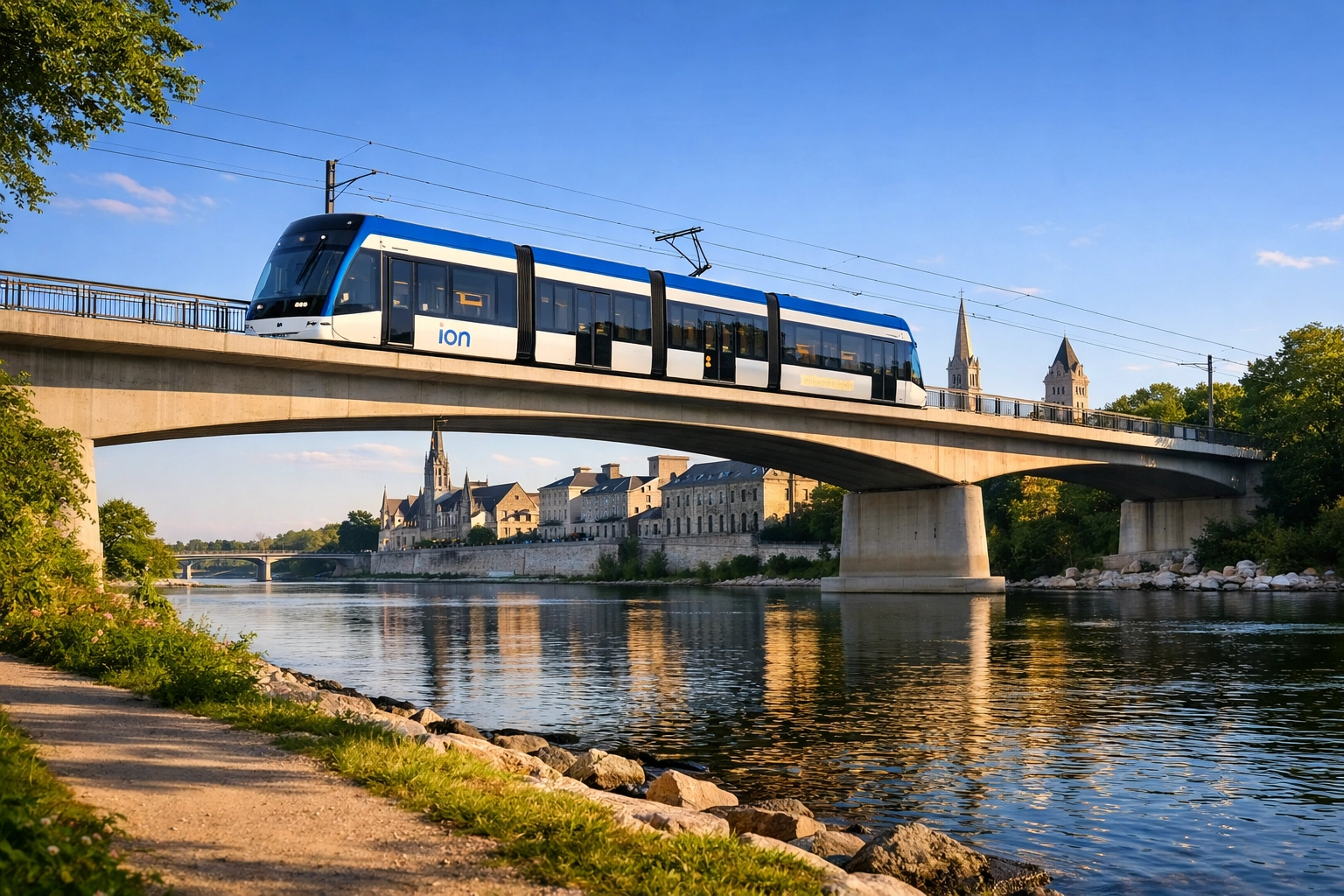
(Alt-text: A modern ION light rail vehicle moving through a busy urban centre, representing the future of Cambridge transit connectivity.)
Understanding the “Transit Premium”
In real estate, we talk a lot about location, location, location. But specifically, we talk about “The Transit Premium.” This is the quantifiable increase in property value that occurs when a home is located near a high-order transit station (like the LRT).
Historically, in cities across North America, properties within 500 to 800 metres of a rapid transit station command a higher price than similar homes further away. In the Waterloo Region, we saw this happen in real-time during Phase 1. According to Regional data, Phase 1 catalyzed over $5.25 billion in development along the Central Transit Corridor.
The interesting part? You don’t have to wait for the train to arrive to see the value go up.
The “Anticipatory Lift”
Real estate markets are forward-looking. Investors and savvy homebuyers don’t buy for what a neighbourhood is today; they buy for what it will be in five or ten years. This is called “anticipatory lift.”
Even though the Phase 2 tracks might not see a train until the early 2030s, the mere endorsement of the $4.5 billion business case this month acts as a “de-risking” event for developers. It tells the market: This is happening.
If you own a home in the Hespeler Road corridor or near the proposed stations in Preston or Galt, your “transit premium” is likely already baking into your home’s equity. People are willing to pay a bit more now to secure a spot in a neighbourhood that will eventually have a 29-minute car-free commute to Kitchener.
Why the South End is the Spot to Watch
While the entire 17-kilometre route is significant, the south end of Cambridge is particularly interesting. Areas that were once seen as purely suburban or “car-dependent” are being reimagined.
We are seeing a shift from traditional single-family detached homes toward mid-rise developments and mixed-use spaces. If you take a drive down Hespeler Road, you can already see the seeds of this change.
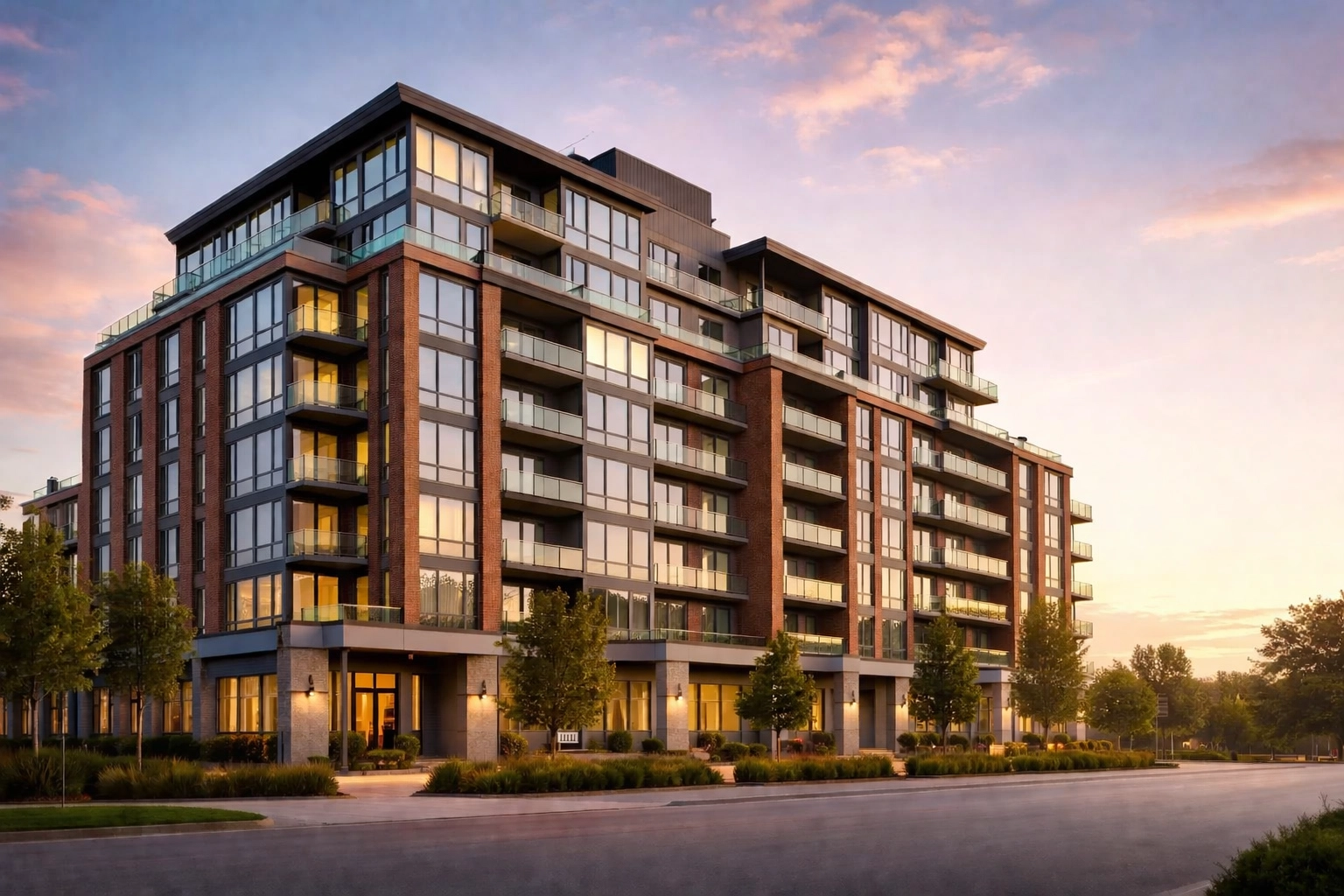
For homeowners in the south end, this means a few things:
- Increased Demand: As the project moves through the detailed design phase, more buyers will specifically search for homes near the future ION stops. You can check out my guide on 5 things you should know when looking for a home near a transit hub for a deeper dive into this.
- Zoning Changes: With the LRT comes “Major Transit Station Areas” (MTSAs). The provincial government and the Region often up-zone these areas to allow for higher density. If you own a larger lot near a proposed station, your land value might have just skyrocketed because of its redevelopment potential.
- Commercial Growth: It’s not just houses. The $4.5 billion investment includes six new major bridges and significant utility upgrades. This infrastructure attracts retail and professional services, making your neighbourhood more walkable and desirable.
Is It a Gamble?
I’ll be honest with you: $4.5 billion is a lot of money, and securing the full funding from provincial and federal partners is still the final hurdle. The recent 5-4 council vote shows that local support has its conditions.
However, looking at the success of Phase 1 in Kitchener and Waterloo, the precedent is strong. The ION has fundamentally changed how those cities function and how their real estate is valued. Cambridge is the final piece of that puzzle.
For those worried about the “construction years,” I hear you. It won’t be easy. But for the long-term homeowner, the temporary inconvenience of orange pylons is usually rewarded with a permanent lift in property value. If you’re wondering how this affects your specific street, you might want to look at navigating your next chapter as a seller.
The Road Ahead
The project has now entered the detailed design phase. Regional staff are currently assessing heritage elements, utility relocations, and the exact footprints of the 14 stations. Public support remains high, with 78 percent of surveyed residents supporting the full connection to Downtown Cambridge.
The “Transit Premium” isn’t a myth; it’s a proven economic driver. Whether you are a first-time buyer trying to get into the market or a long-time resident of Galt or Preston thinking about your retirement nest egg, the LRT is the most significant factor in Cambridge real estate for the next decade.
If you’re curious about how much “anticipatory lift” your home has already gained, or if you’re looking to invest in the corridor before the tracks are laid, let’s chat. I spend my time digging into council minutes and regional reports so that I can give you the most accurate, boots-on-the-ground advice.
Whether you’re buying, selling, or just trying to make sense of the latest council vote, I’m here to help you navigate the Cambridge market with confidence.
Ready to see how the LRT impacts your property value?
Whether you’re looking for a mortgage pre-approval to start your search or just want to use a mortgage calculator to see what’s possible, I’m your resource.
Kim Louie, Real Estate Broker partnered with Coldwell Banker Peter Benninger Realty | Your Waterloo Region Real Estate Resource
📲 519.573.0837
📧 realtorkimlouie@kimlouie.net
💻 www.kimlouie.net
*** Not intended to solicit clients under contract. Content is for informational purposes and not guaranteed nor warrantied ***
#CambridgeRealEstate #IONPhase2 #WaterlooRegion #LRT #CambridgeOntario #RealEstateTrends #TransitPremium #KimLouieRealEstate #OntarioHousing #Galt #Preston #Hespeler
